

You see the Bent Pyramid and stop. The slope shifts halfway up. It looks “wrong,” but it’s not. You’re looking at a live record of problem-solving in stone. This particular pyramid is located at Dahshur, which is south of Cairo. It was built for the Egyptian King Sneferu between 2600 and 2500 BCE during the 4th dynasty of Egypt. One of the objectives was the completion of a true pyramid. Not a step pyramid. A perfect, symmetrical triangle shooting up from the sands of the desert.
Dahshur sits away from heavy crowds. The desert there feels open and quiet. Sneferu’s builders worked fast and learned fast. They were moving from earlier step designs toward a new form. They aimed high. They faced trouble. They adapted.
Look at the base. The lower half rises steeply. Halfway up, the angle softens. That change makes the “bent” outline. Most researchers agree on the reason. The original angle put too much pressure on the lower courses. The ground under parts of the base was not uniform.
Cracks and small shifts likely appeared. The engineers saw risk. They changed the plan mid-build. They cut the upper courses at a gentler angle. That reduced weight and stress. It wasn’t a mistake. It was a fix that saved the structure.
Many pyramids lost their outer casing long ago. The Bent Pyramid kept much of its smooth Tura limestone shell. You can still see tight joints and polished faces. Stand near a corner and study the precision.
You get a rare look at how a finished pyramid once gleamed in the sun. The casing also seals the core from wind and sand. That’s one reason the pyramid still looks sharp today.

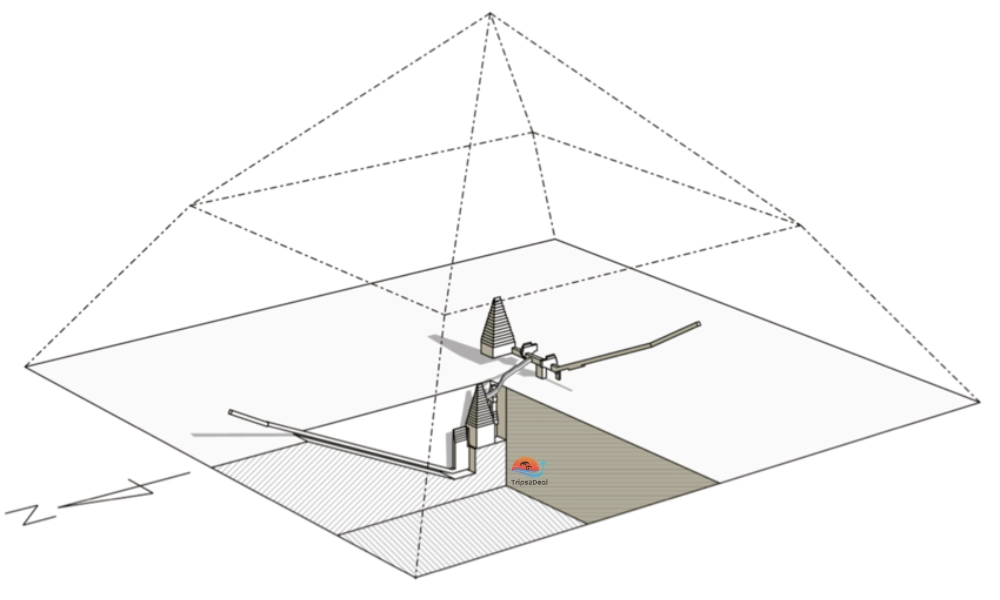
This pyramid surprises you inside. It has north and west entrances. Each leads to its own passages and chambers. The chamber ceilings use corbelling, layered stone steps that push weight outward and down. This spreads the load and prevents collapse.
You walk through low corridors, then step into high, airy spaces. You feel how design controls stress. The dual routes suggest testing. The team tried multiple layouts in one project. They were learning what worked best for a true smooth-sided pyramid.
Sneferu didn’t stop with one try. The Red Pyramid is north of the Bent Pyramid. It uses a single, shallower angle from base to top. Many see it as the perfected version of the idea. In that sense, the Bent Pyramid is the bridge. It links older step forms to the clean triangles you know from Giza. Without this “bend,” later pyramids might not look the way they do.
While it’s not the tallest building in Egypt, the Bent Pyramid is still rather impressive at over 100 m tall. The base stretches wide across the sand. The faces catch light throughout the day. Because Dahshur is quieter than Giza, you sense the structure more. No constant noise. Just wind, stone, and the skill of thousands of hands.
The name can fool you. “Bent” sounds like failure. It isn’t. It’s a snapshot of real-time engineering. The builders found a problem. They adjusted. They kept the vision and changed the method. Test, measure, adapt, and continue anywhere. Not all progress is straight. Sometimes the smartest line bends.
Make a list of what you need to do to get out of bed faster. This place is outside of Cairo's biggest ring road, so you can go away from the city's peace.
You should bring drinks, sunscreen, and comfortable shoes. Be nice to the people who live there and pay attention to signs and symptoms to find your way. Kindness goes a long way.
It's usually great to take pictures outside. There may be different rules for taking pictures inside. If you can, go to the Red Pyramid on the same day. Think about angles. The rooms are next to each other. You might notice a difference from hard to easy right away.
This monument shows the moment when ambition met reality. It proves ancient Egypt didn’t just copy formulas. It experimented, learned, and improved. The Bent Pyramid keeps its casing, its clean lines, and its story. It tells you that changing course can be wise, not weak. It shows you how a tough call can preserve a dream.
Stand at Dahshur and trace the break in the slope with your eyes. Picture engineers spotting hairline cracks. Picture the order to reduce the angle and recut blocks. Hear the tools. Feel the urgency. Then look up at what still stands. The pyramid is strong because someone chose stability over symmetry. That choice turned a risk into a lesson and a lesson into a landmark.
© 2025 trips2deal. All rights reserved