

The Giza Plateau is west of the Nile, where you are. You're not as far ahead as Cairo. There are three well-known mounds in front of you. This is the Giza Pyramid Complex. The place you see is holy, a royal graveyard, and a work of engineering art.
Start with the largest structure. King Khufu owns the Great Pyramid. Builders raised it around 2550 BCE. They used millions of limestone blocks. Each block weighs like a small car. You see rough, weathered stone today.
A long time ago, a smooth white casing covered the pyramid. Sunlight made the sides shine. The pyramid points to the four cardinal directions with striking accuracy. That precision still impresses surveyors and architects.
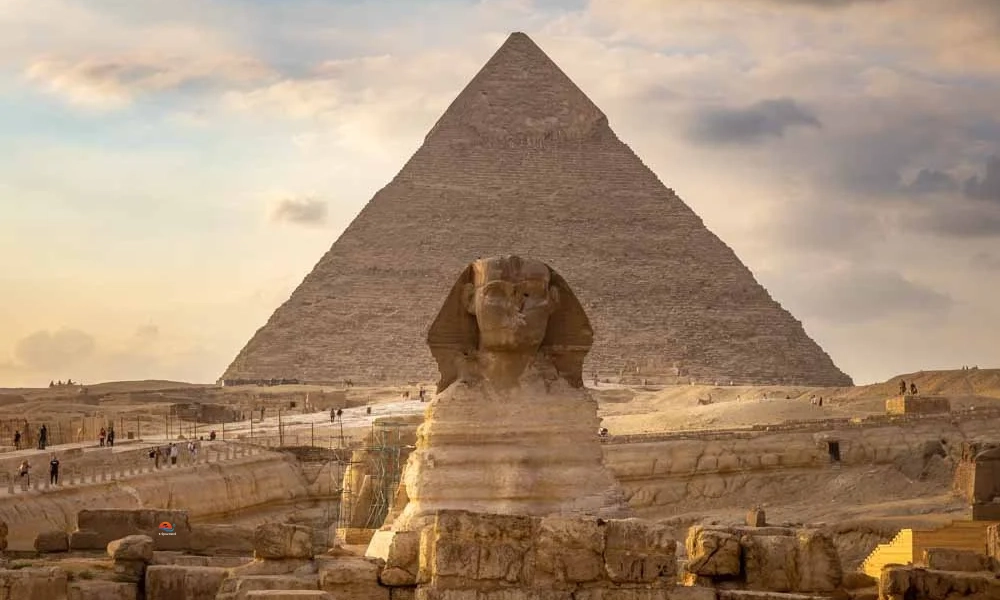
This is where the Pyramid of Khafre is. It looks taller because the gap is bigger. A cap of casing stones clings to the top. It shows how the whole pyramid once shone. Khafre’s complex also includes an icon, the Great Sphinx.
You can spot a cap of casing stones near the top. That cap hints at how the entire pyramid once looked. Khafre’s complex includes something iconic.
The Great Sphinx is hunched over on the edge. It looks like a lion but has a human head. According to many experts, Khafre is involved. The Sphinx faces east, where the sun sets. It quietly guards the cemetery.
Menkaure owns the smallest of the three massive pyramids. It uses limestone and granite together. Granite lines the lower courses and temples. The mix shows careful planning and aesthetic taste.
Menkaure’s complex also includes three small “queens' pyramids.” You'll see similar satellite pyramids near Khufu and Khafre as well. These smaller pyramids held royal women or symbolic burials.

Look closer, and you will notice more than just pyramids. Each king built a mortuary temple beside his pyramid. Priests performed rituals there. A long stone causeway linked that temple to a valley temple near the Nile floodplain. Processions moved along the riverside path. Boats could deliver offerings through canals during the flood season. The layout tied river, desert, and sky into one sacred system.
At Khufu’s pyramid, boat pits hold full-sized wooden ships. One famous example was reassembled and displayed for years. These solar boats likely served the king’s journey with the sun god.
They also show advanced carpentry with rope stitching and no metal nails. When you picture Egypt, think beyond stone. Think wood, rope, copper tools, and skills passed down over generations.
Construction logistics still spark debate. You will hear about straight ramps, zigzag ramps, and internal ramps. Archaeology suggests teams quarried local limestone on site. They hauled finer Tura limestone from across the river. They brought granite from Aswan, far to the south.
Workers used sledges, rollers, and water to reduce friction. You can visit the worker village, which remains south of the plateau. There you see bakeries, barracks, and workshops. The workforce was organized, fed, and housed. This was not a story of slaves alone. It was a national project with seasonal labour and trained crews.

Walk around and watch the ground. Mastaba tombs spread out like city blocks. They belong to nobles, officials, and family members. Reliefs and inscriptions fill many walls. Names, titles, and offerings appear in careful rows.
These tombs tell the story of court life and administration. They also reveal the scale of the operation. You need scribes, cooks, brewers, stonemasons, and boatmen to build a pyramid. Everyone leaves a trace.
Orientation matters here. The pyramids align with the cardinal points and echo the belt stars of Orion in some interpretations. At a minimum, the builders tracked the sky with care.
The builders used the night sky to establish lines and angles for the pyramid's design. They also tied the complex to the annual flood and the sun’s cycle. Death and rebirth flowed through this design. You stand inside a cosmic model carved in stone.
Schedule a visit day. The plateau feels wide open, so bring water and shade. Choose a ticket that includes a pyramid interior if you want to enter. The passages are narrow and warm. Move slowly and watch your footing. Inside, you sense the precision even more. Blocks fit tightly. Chambers sits exactly where planners intended.
Step back and take in the whole scene. River, city, desert, and sky meet at this edge. The Giza Pyramid Complex is not just three triangles in the sand. It is a royal program, a religious machine, and a national workshop. You see faith expressed as architecture. You see organization turned into geometry. You see ambition that still speaks after 4,500 years. And now, you stand in that story.
© 2025 trips2deal. All rights reserved