

The smallest of the famous pyramids of Giza is called Menkaure (or Mykerinos), yet it still has its character. It was built during the 4th dynasty of Menkaure (reigned in the mid-25th century BCE), immediately southwest of the larger pyramid of Khufu and Khafre, and makes up the archetypal desert side skyline. Smaller, approximately 65 meters high with a base around 102 meters on a side, it provides some of the most interesting hints at the royal ideology, quality, and planning of a temple at the very end of the period of great pyramid construction in Egypt.
It is probable that Menkaure succeeded Khafre and inherited not only the religious landscape of Giza but also its extensive labour systems and hunting systems. By his time, pyramid building had become a complex and nearly well-developed industry.
Despite this, there are indications that Menkaure had not died by the time all these features were complete, and it was likely Shepseskaf who completed the mortuary complex in brick over stone, an aspect that speaks both to time constraints and to shifting priorities at the end of the Fourth Dynasty.
The brightest aspect of the pyramid of Menkaure is its striking casing: the lower was clothed in hard, pinkish Aswan granite (part of which is still strongly polished), the higher in beautiful Tura limestone. That bicolour would have shone in the sun, heavy, grave granite at the base, and light limestone at the summit.
The interior scheme of the pyramid is small and effective, the passages decreasing in size, and the chambers are paved in granite. The inside of Menkaure is less majestic than the confined inner galleries of the pyramid of Khufu, yet technically excellent.
Four smaller pyramids, called G3-a, G3-b, and G3-c, can be found to the east of the main pyramid. The royal family was the focus of rituals held at Giza. These small satellites fit in with that. The churches and graveyards on these small worlds demonstrate how difficult court life around the king was.

A stone causeway linked the mortuary temple of Menkaure (beside the pyramid) to the valley temple (beside the Nile floodplain). These temples, built years after the king's death, were architectural phases of daily offerings and royal cult practices.
In the valley temple, digs revealed the famous triads of Menkaure, Hathor, and local nome goddesses. These statues convey the idealized youth, power, and close association of the king with both the Gods and the provinces of Egypt. They are masterpieces that enhance our understanding of the graphic representation of kingship in terms of style and preservation.
You can see a big cut on the north face. It dates back to when people attempted to remove stone in the 12th or 13th century by dismantling the pyramid. During the Middle Ages, workers could carve out a sufficient number of blocks to leave the wound visible to the present, but soon it was too costly to continue.
Strangely, the partial destruction shows how strong the original engineering was and how expensive it had become to hew out finished pyramid stones when fresh rock was available.
The pyramid of Menkaure is a giant logistical impression, even by the standards of the small Gizas. Granite was forced to be cut close to Aswan, hundreds of kilometers up the river, and then transported and placed upstream with precision.
People who planned the work, wrote down instructions, cut stones, built walls, sailed, watched over, cooked, and treated people were needed.
During months of inundation, the supply chains aligned quarry production with seasonal Nile traffic and manpower supply. The outcome is a monument that concentrates the state power into geometry, light, and stone.
The pyramid of Menkaure has been lauded based on its human scale. You can be close to its base and admire individual granite blocks, the marks of the tools, and the finishing choices made by the artisans.
Together, comprised of queens' pyramids, causeways, and temples, Giza begins to move toward being more of an integrated ritual campus rather than merely an expression of a large scale. The sculpture program within the same place provides a layer of culture that competes with architectural accomplishment.
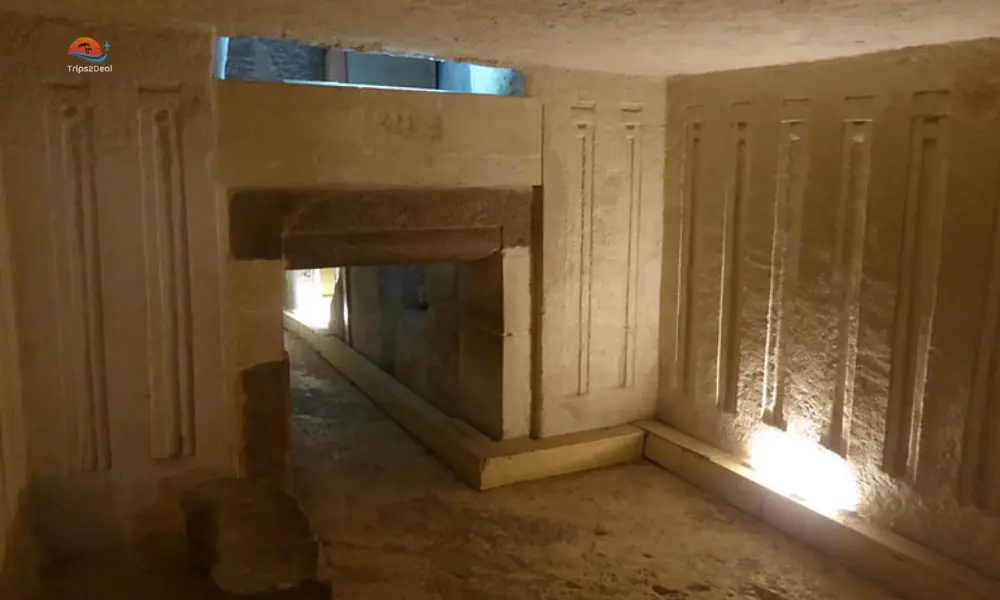
Menkaure is the finest and most inviting of all three pyramids of Giza, though the smallest in size. The granite and limestone structure and its magnificent shrines and statues show that the king wanted to show his dominance through handicraft and not brute force. An excavation from the Middle Ages, the fact that Shepseskaf must have been finished late, and the fact that her stonework has never been used again are all examples of monuments that have changed politics, economies, and climates. Shepseskaf left behind one of the clearest declarations of divine kingship made in marble.
© 2025 trips2deal. All rights reserved